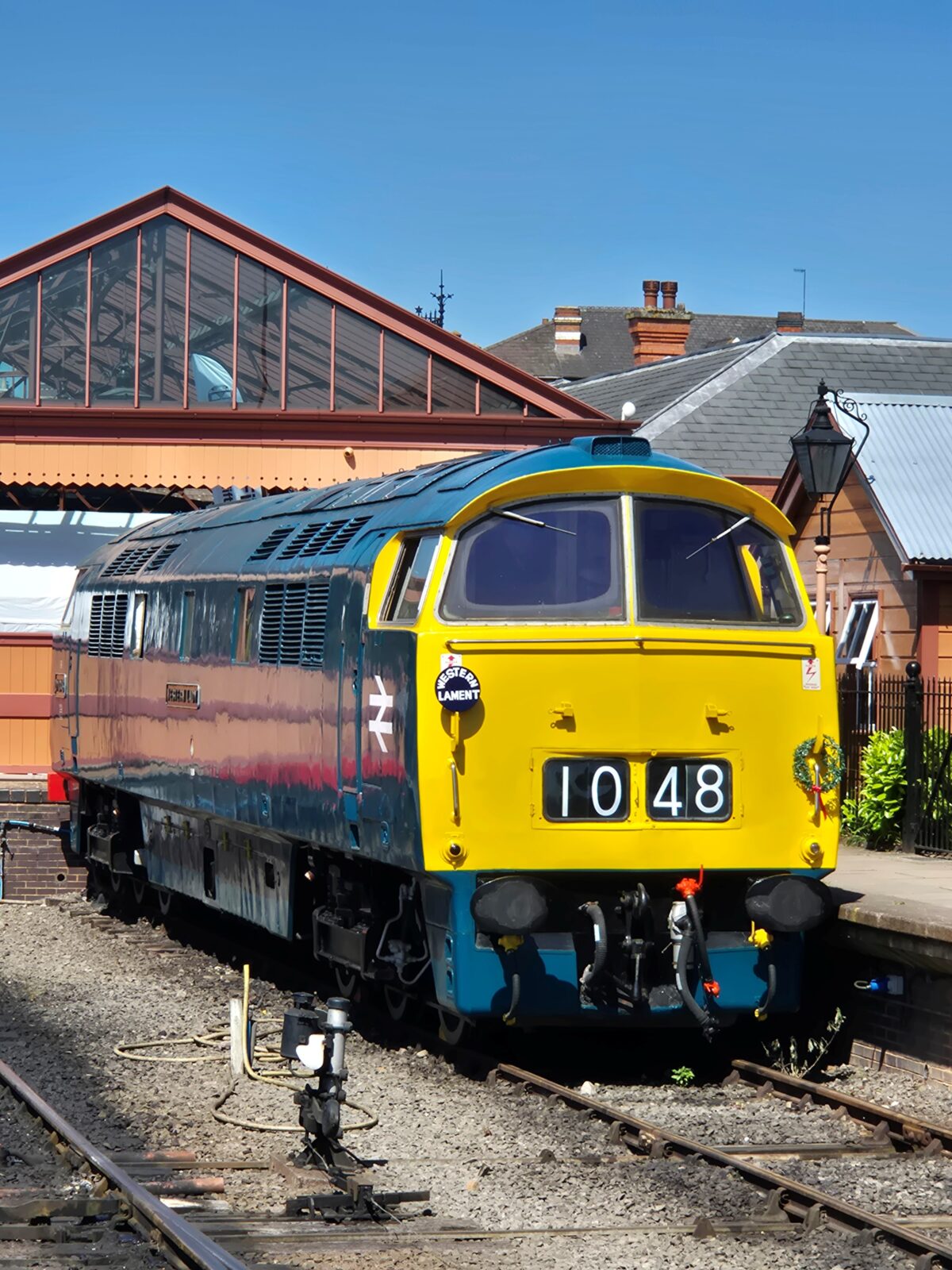
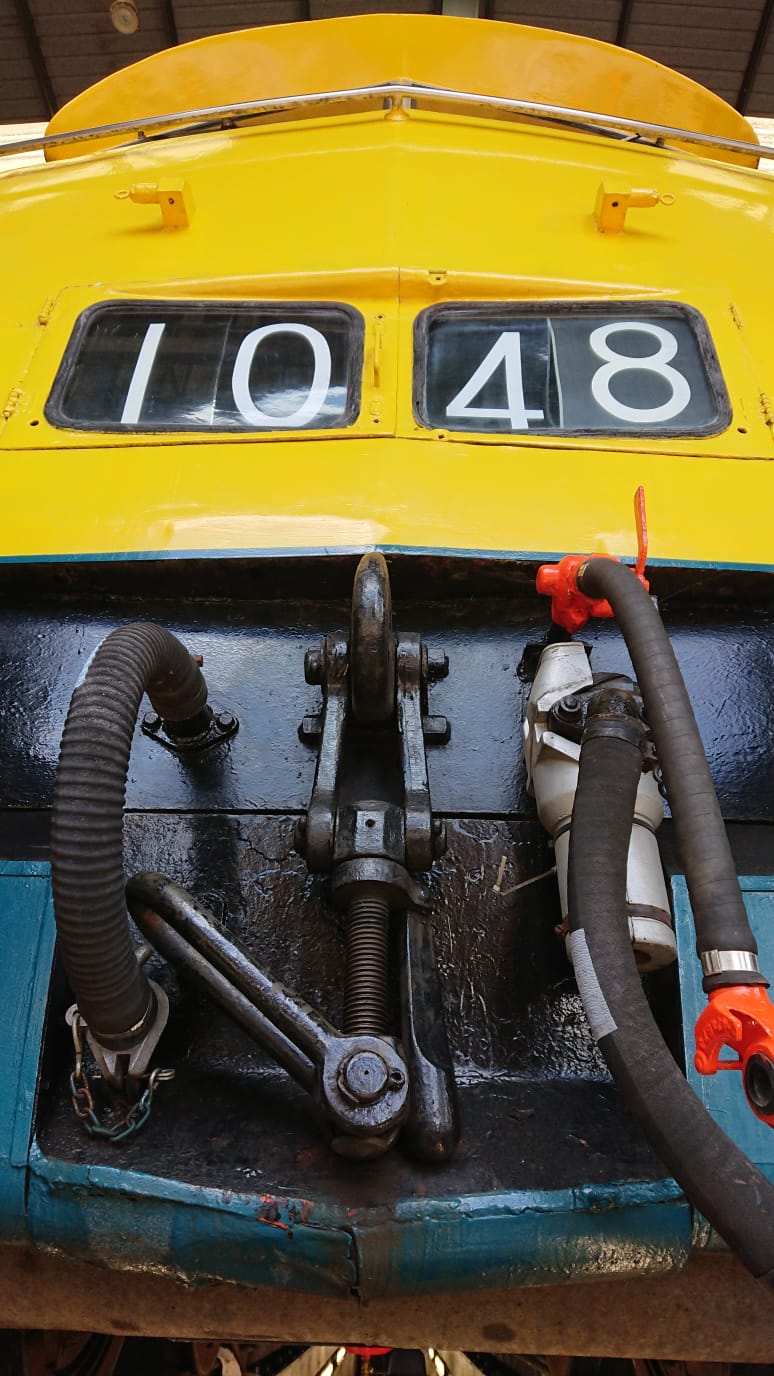
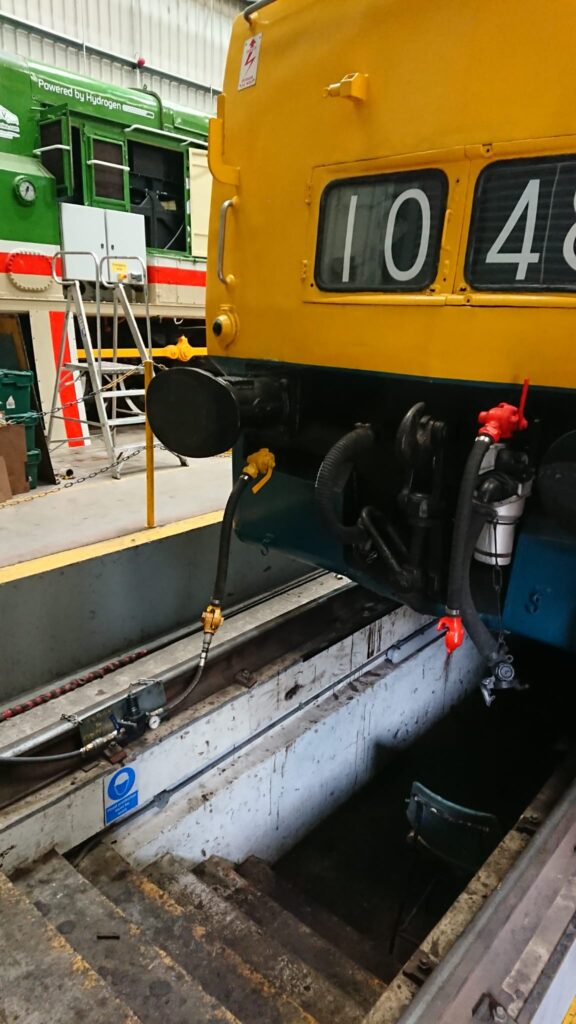
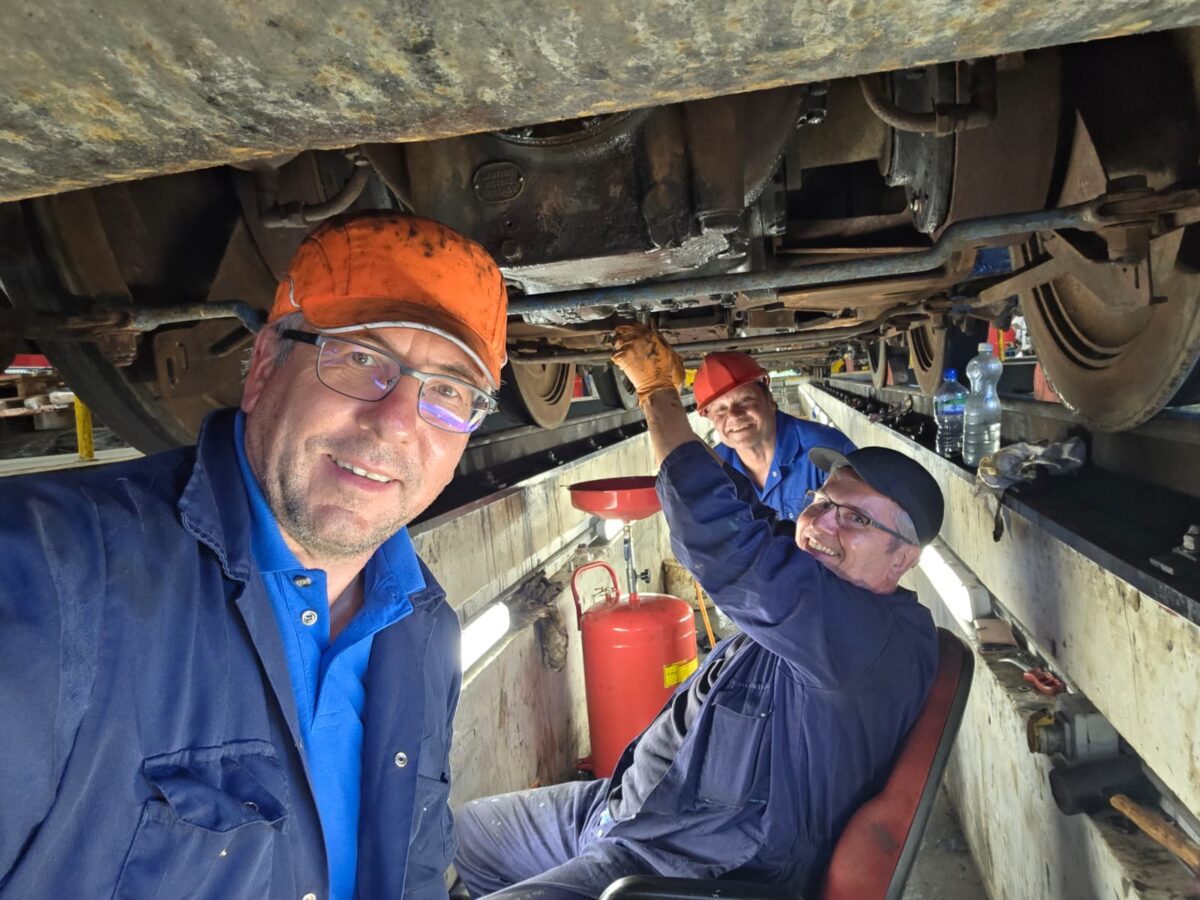
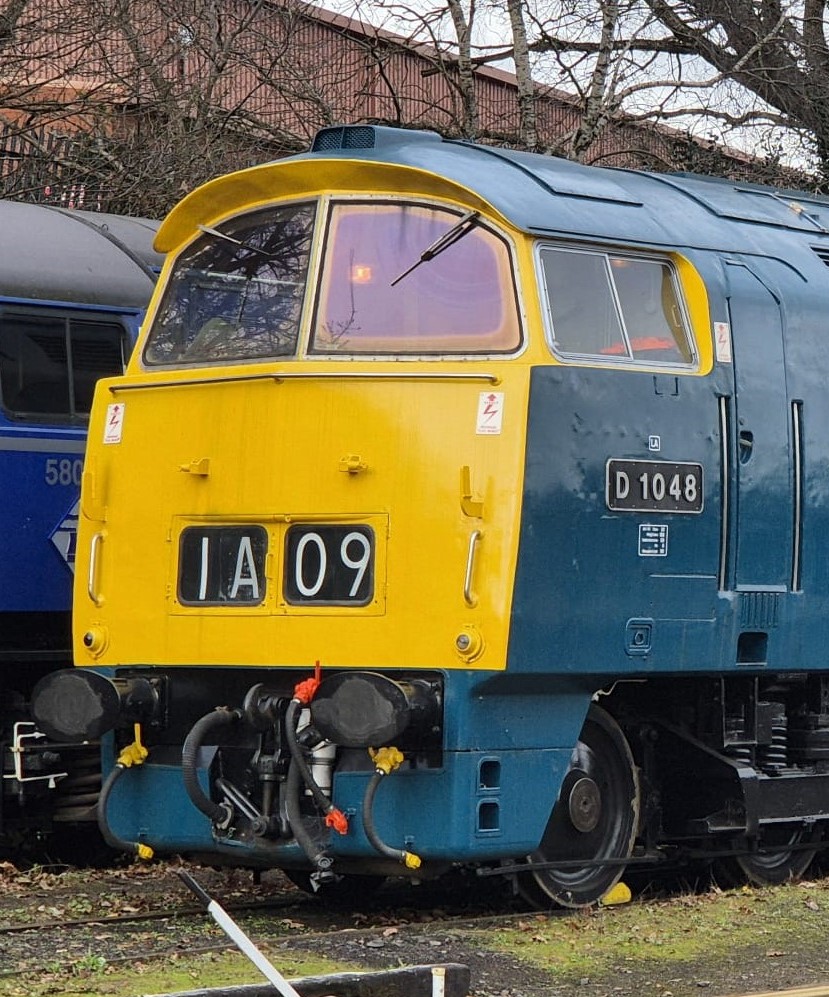
The latest update on D1048 has been provided by Mike Targett, as follows:
Air Brakes
“B” end small air compressor has had its covers removed and internals inspected. All brush gear has been freed and commutator given a light clean. “B” end small air compressor to be energised to establish whether it is operational.
Dynostarters
All 8 brushes on “A” end dynostarter have been freed. It maybe worth noting that to free the last set of brushes necessitated the removal of the entire arm carrier so that the brushes could be worked on externally. “A” end dynostarter commutator has also been cleaned. “A” end dynostarter is now primed and ready to be energised to see if it will turn over “A” end transmission and in turn, “A” end engine and “A” end serck pump.
“B” end dynostarter was noted to be exhibiting electrical arching when previously energised. “B” end dynostarter has had all brush gear removed and individually cleaned whilst the commutator itself has also been cleaned.
Electrical Control Circuits
“A” end oil pump unresponsive when energised from oil sample button on “A” end engine.
In contrast “B” end oil pump successfully ran when energised from oil sample button on “B” end engine.
Electrical Power Circuits
During our last report we stated that in order to assess the electrical power circuit assessment at “A” end required “A” end engine to be filled with oil. Used engine oil was sourced (ex-D821A) and attempts were made to fill “A” engine with this oil. However, during this operation the most likely explanation as to why this engine was delivered dry became apparent. “A” end engine oil fill/drain pipe was found to be split. Fortunately this issue was discovered immediately and alternative means of filling “A” end engine with oil were made. However, a further issue was then discovered. The saunders value connected to “A” end engine oil isolating cock would not fully close. The combination of these two issues means that D1048’s “A” end engine is unable to hold its own oil! The oil has subsequently been drained back into the drum from which it came. As a minimum “A” end engine oil fill/drain pipe to be replaced in order to progress “A” end electrical power circuit, “A” end engine, “A” end oil pump, “A” end transmission, “A” end serck pump and “A” end dynostarter assessments.
Electrical Control Circuits and Electrical Power Circuits Combined
Following the previous success at “B” end, the working members carrying out D1048’s assessment decided to perform a mock engine start to see if both electrical control circuits and electrical power circuits would work in unison.
With the engine water level and engine water temperature safety alarms temporarily overridden a drivers key was inserted into “B” end directional controller. “B” end engine start button was suppressed and “B” end oil priming pump successfully run. When the correct oil pressure was reached “B” end start contactor automatically successfully made and “B” end dynostarter turned over “B” end transmission and in turn, “B” end engine and “B” end serck pump with no issues reported.
Based on the above the WLA is now in a position to make the following statement:
“The WLA can confirm that on the electrical power side AND electrical control side, D1048, in her current condition, is capable of starting “B” end engine”.
The latest update on D1048 was provided by Mike Targett at the WLA’s Annual General Meeting held on the 15 November 2025. All images and footage courtesy of Jeff Targett, Mike Targett, Mike Tromans & Sally Sheldon….
Electrical
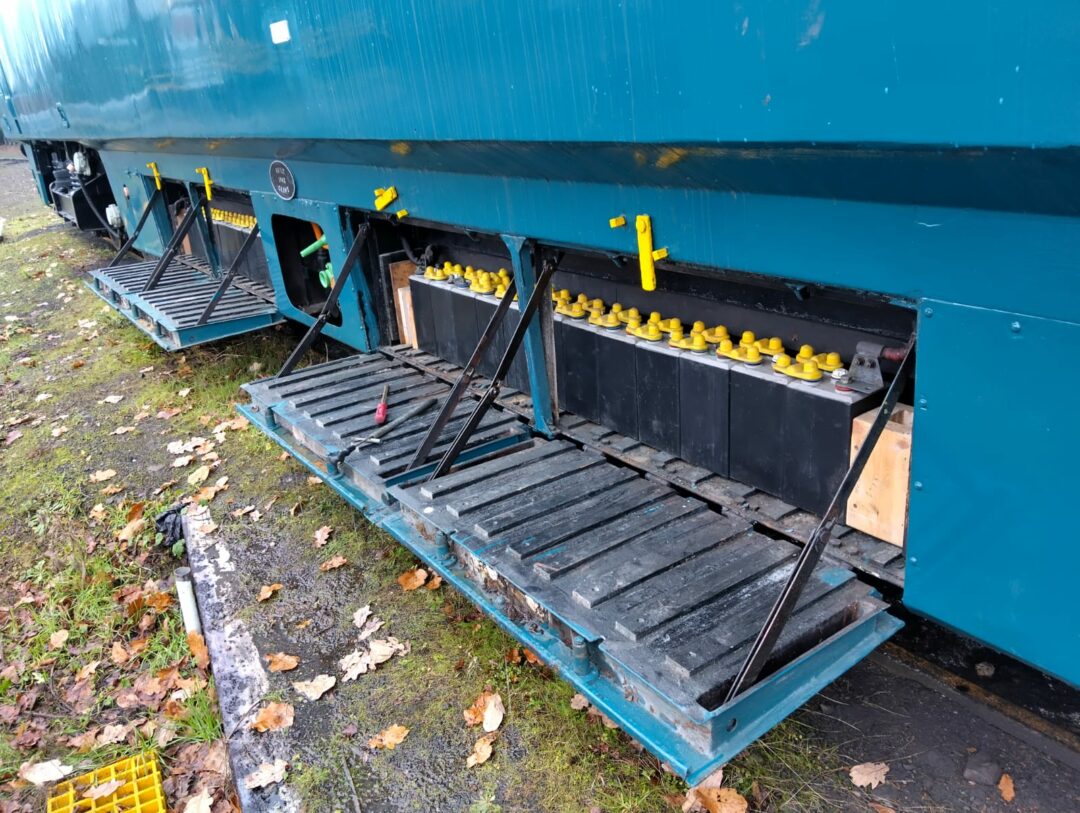
The new set of batteries have had all connections fitted and are now fully prepared to be connected to D1062. With D1062 being called to cover services due to the summer steam ban, as well as an already hectic schedule, there was simply not a sufficient gap in D1062’s operational commitments to remove Courier’s set of batteries. As a result, the new set of batteries have been temporarily fitted to D1048 so they can be put on charge to preserve their longevity. Naturally this opportunity has not been missed to progress Lady’s electrical assessment.
Dyno starters
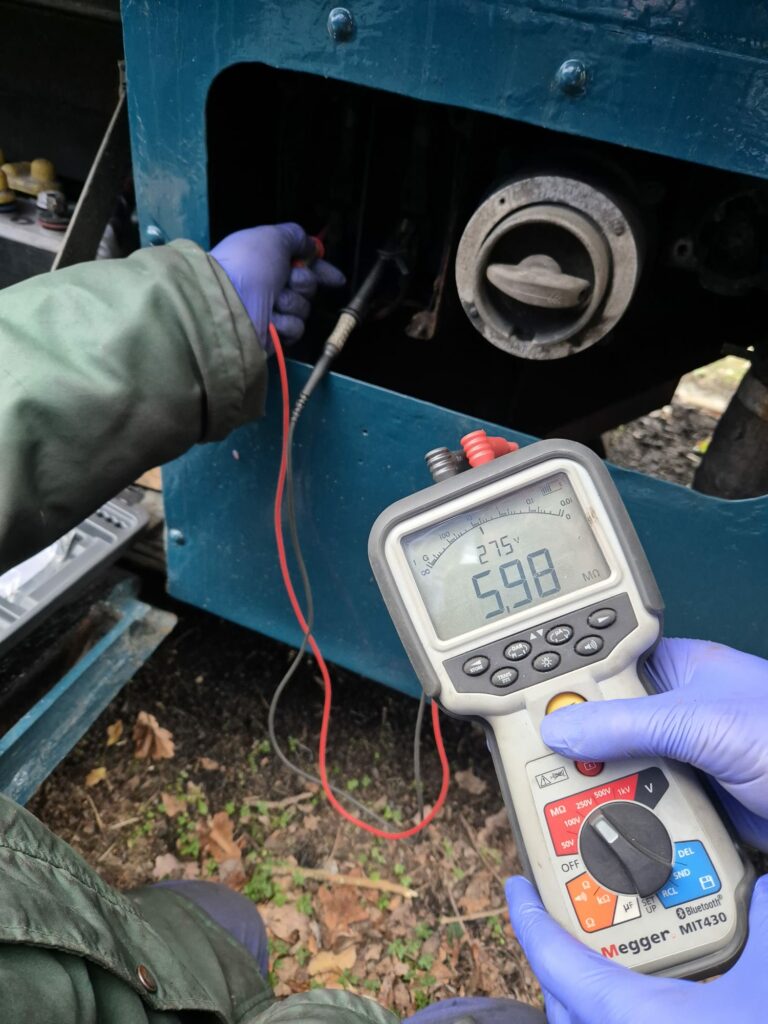
Both dyno starters have had their inspection covers removed for visual inspection of comm and brush gear. “A” end was found to have 3 of the 8 brushes seized, one of these seized brushes has been freed with the other two being a work-in-progress. “B” end has all 8 brushes free. All 4 supply cables on “B” end dynostarter have been subject to insulation testing and are within specification.
B end dynostarter turning over B end transmission and B end Serck pump
Final drives
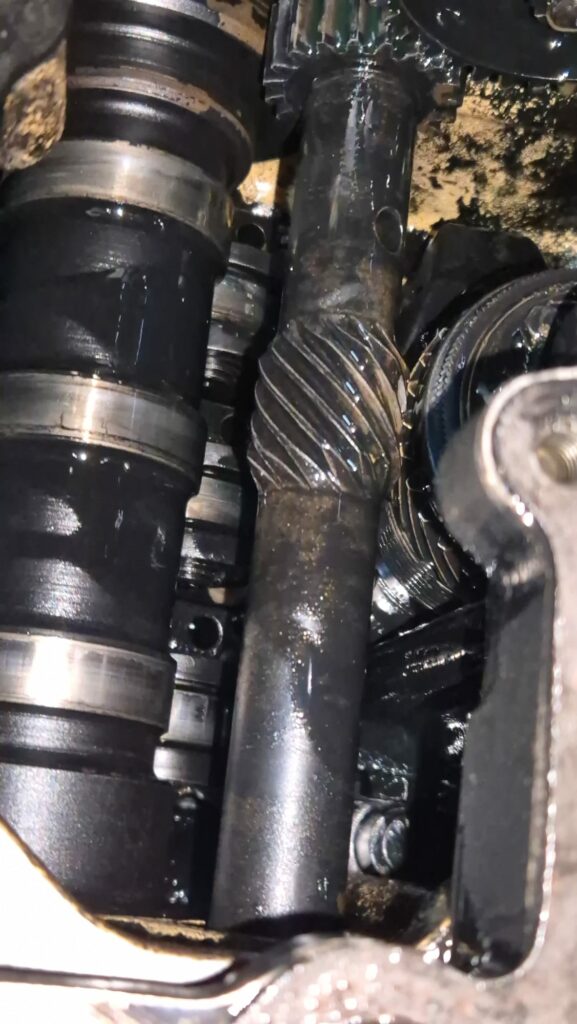
All 3 final drives on “A” bogie have received an oil change. As part of the oil change the opportunity was taken to assess the final drives. Once the existing oil was drained the bottom plate housing the oil pumps were removed and internal areas inspected. All 3 oil pumps were found to be in working order in both directions, cleaned and filters removed and themselves cleaned. All visible bearings and surfaces are as expected. Fresh oil inserted following completion of each individual assessment. Additional attention was given to final drive #2 (centre axle) as this is the final drive reported to have run hot many years ago. Final drives 1 & 3 were reported to be in “very good” condition following everything looking as expected after visual assessment.
D1048 Final drive #2 inspection plate being removed
The entire internal area of final drive #2 was cleaned to assess it’s internal condition. Slight signs of water ingress was evident with mild corrosion and slight pitting visible on internal casing and pump body. Old oil was found to emulsified. Old oil was put through a sieve with no debris of any kind collected. No bluing visible on any surface whatsoever, including gears and bearings. Small bearing also assessed and discovered to be in good condition with no play, another very encouraging sign.
Air Brakes
D1048 has received an initial air brake assessment.
D1048 initial air brake pipe assessment
With the air brake system back fed two massive air leaks immediately presented themselves. Their locations and cause are as follows:
Behind “B” side valance due to a missing spirax valve.
“B” end cab. The cause found to be all three connections to the main air reservoir control box being disconnected.
D1048’s Spirax valve has since been located.
The WLA have yet to confirm but during the hand over procedure of D1048, the previous owners informed the WLA that a section of air brake pipe, underneath the engine room floor at “B” end, was found to be badly corroded and removed.
Spirax valve to be re-fitted, air reservoir control box connections to be remade and a new section of air brake pipe to be installed, to progress air brake assessment.
Vacuum Brakes
Both vacuum exhausters have had their inspection covers removed, comm and brush gear assessed. Internals of both exhausters looked to be in very good condition. All 8 brushes on exhauster #1 were found to be free. Both vacuum exhausters have been energised from switches on Davenset and both ran as expected with no issues reported.
Both vacuum exhausters operational.
D1048 both vacuum exhausters in operation
We are unable to verify the integrity of the vacuum brake system as all 4 vacuum gauges (2 in each cab) have been removed.
Vacuum gauges to be replaced to progress vacuum brake assessment.
Miscellaneous
The damaged-beyond-repair due to water ingress internals of “A” end overspeed unit have been replaced with a spare.
Electrical Control Circuits
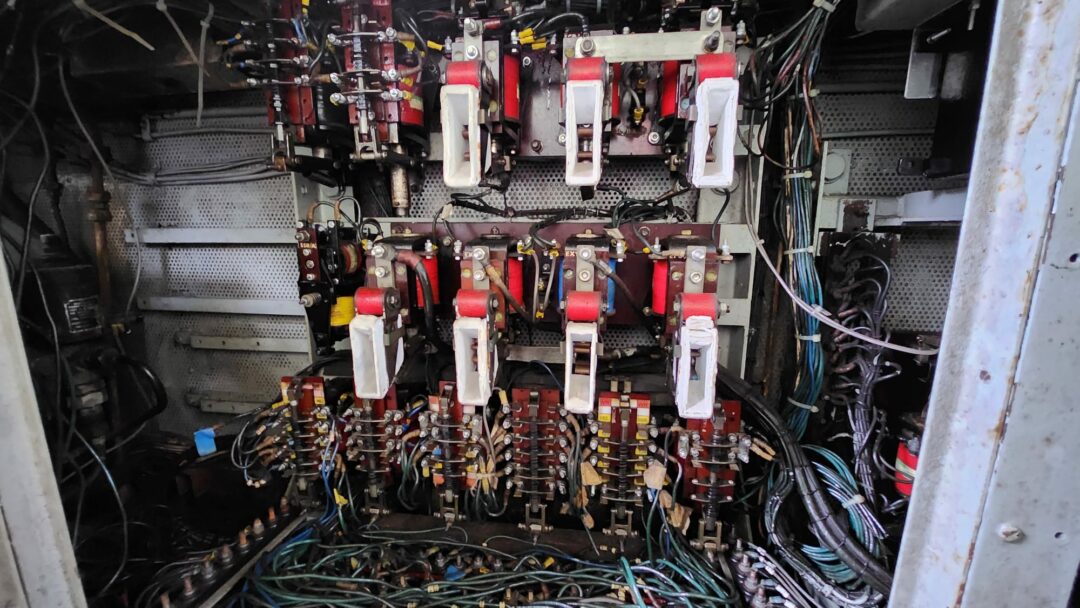
The 2 major earth faults at “A” end have been revisited. The 2 cables have been traced through to the instruments they supply and disconnected. Both wires were then earth tested again to find, on both counts the faults remain. This proves that the major earth faults are with the wires themselves and not the equipment they supply. Further investigation required.
Electrical Power Circuits
With “B” end dynostarter having passed megga testing and found to be free, “B” end oil pump was then run to lubricate “B” end engine, showing 80 psi at the engine oil pressure gauge. With the new set of batteries fitted “B” end dynostarter was energised and successfully turned over “B” end transmission, which in turn, turned over “B” end engine and “B” end serck pump. All four components responded as expected with no issues reported.
D1048 B end engine being turned over by B end dynostarter
Based on the above we are now in a position to make the following statement:
“The WLA can confirm, that on the ELECTRICAL POWER side D1048, in her current condition, is capable of starting “B” end engine”
Following this milestone success, the team of working members involved have set about trying to achieve the same results from “A” end.
“A” end engine oil priming pump was previously reported to be unresponsive when energised. “A” end oil pump has been revisited. On secondary inspection it was found that despite the full 110v leaving number 1 electrical frame 0v were arriving at the pump motor. The wires in question were traced to the nearest electrical junction box were the wires were retested. The full 110v were recorded at this point. “A” end oil pump motor was then separated from the pump itself and, using “A” cab desk as a temporary work bench, it was discovered that the motor had a missing brush, missing cable gland and the comm to be very dirty. The comm was cleaned, a replacement brush sourced and fitted, a replacement cable gland sourced and fitted, and, using off-cuts from D1013’s re-wire, the motor re-wired with approximately 1 metre long tails. The motor was then energised on “A” cab floor and ran. The motor was then re-fitted to “A” end oil pump with the new wiring pulled through the existing electrical conduit and connected to the original wiring in the aforementioned electrical junction box. “A” end oil pump was then energised via the oil pump relay under the desk at “A” and ran with no issues reported.
D1048 A end engine oil priming pump now operational
“A” end engine oil priming pump now operational.
“A” end engine dipstick was then dipped and found to be bone dry.
“A” end engine to be filled with engine oil and the last 2 seized brushes of “A” end dynostarter to be freed in order to progress “A” end engine, “A” end oil pump, “A” end transmission, “A” end Serck pump, “A” end dynostarter and “A” electrical power circuit assessments.
As of the end of June 2025, the team has continued with the evaluation and assessment of locomotive D1048. Significant progress has been made, particularly on the “A” end bogie, where all three Final Drives have now been cleaned, drained, inspected, and refilled with fresh oil. Greasing has also been completed to prevent further deterioration and to support long-term preservation efforts.
Special attention was given to Final Drive No. 2, which is historically believed to have run hot many years ago. However, a thorough visual inspection has revealed it to be in good overall condition. Further investigation will be carried out in due course to confirm this assessment.
At present, the focus remains on advancing the overhaul of D1013 and ensuring the continued operational reliability of D1062, with D1048’s restoration work continuing as resources allow.
We reported in our December 2024 update that D1048 possesses 5 major earth faults on the control side of her electrical system. 2 of these faults are at “A” end and 3 at “B” end. Surface level investigations have been undertaken on the 2 major earth faults at “A” end but unfortunately we have not been able to locate the source of these faults. A more in depth investigation will need to be carried out on these 2 wires. As D1048 is only being assessed at this time, the decision has been taken to not get “bogged down” in this area and to best spend our time continuing other areas of Lady’s assessment. The working members involved have proven that the fault is with the wires themselves and not the components the wires feed. Both wires have been disconnected and terminated at both of their respective ends. The 3 major earth faults at “B” end have not been investigated.
As per our previous update, the small group of working members have now assessed the power side of D1048’s electrical systems. As a precaution all cables connecting the batteries, the two cables connecting the batteries to the BIS and all four cables connecting the BIS to the main start contactors were “megger” tested. All cables passed. Following this the power systems were engerised with no faults reported. A fantastic find. With this the control circuits were also energised. Both control systems (except for the 5 wires previously mentioned) and power systems have been energised simultaneously with no faults reported. All four main start contactors have been successfully energised and responded as expected. This proves that D1048 is safe and capable of delivering all electrical power required from the batteries all the way through to both sets of start contactors.
An additional electrical note worth mentioning is that all electrical tests undertaken at “B” end have been performed from “A” end. The working members involved have proven on several occasions that the common control and power wiring, which runs end-to-end are in good condition, with the full 110v arriving at “B” end. Another very encouraging sign.
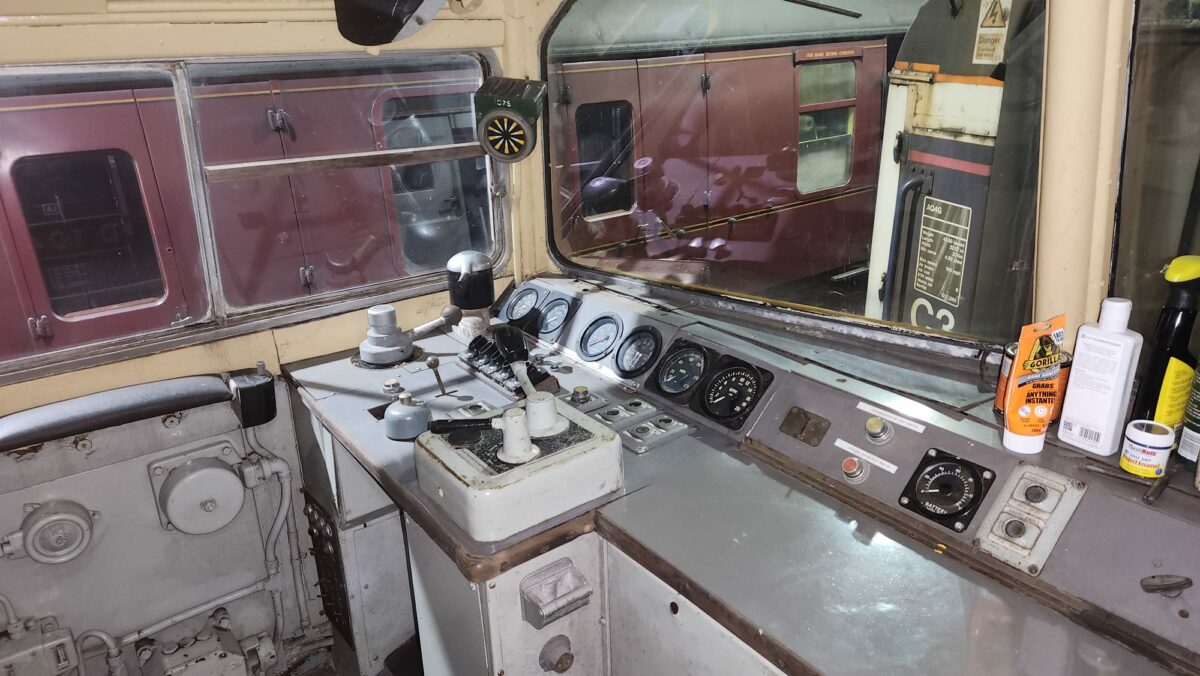
Additional wiring and equipment noted in both cabs over D1013 and D1062.
“A” end engine oil priming pump has been energised but is unresponsive. The motor shaft is free and is able to be turned by hand.
“B” end engine oil priming pump bas been energised and is operational, purring away very nicely.
“A” end preheater is yet to be assessed as it is not in situ.
“B” end preheater is operational and has run. Noted to have an operational damper and timer.
Both fuel pumps were initially seized but have subsequently been freed.
“A” end fuel pump has been energised but is unresponsive.
“B” end fuel pump has been energised, is operational and has been run up.
“A” end engine has had all 6 cam covers removed and top end inspected. The top end of “A” engine is in excellent condition with absolutely no signs of rust or corrosion anywhere.
Oil levels were found to be very low so have been topped up. “A” end engine is free and can be barred over.
“B” end engine has had only the centre cam cover removed on the walkway side at this time. The area inspected is also in excellent condition with absolutely no signs of rust or corrosion anywhere; shiny metal and oil reported in locations as per expectations. “B” end engine is free and can be barred over.
“A” end turbo charger freely spins.
“B” end turbo charger seized.
All warning instruments on both desks now have a full complement of lamps.
A driver’s key has been inserted into both power controllers with power and control circuits live with the following noted:
“A” end – “reverse engine only” unavailable. No response from any relays or solenoids when entered into “forward” or “reverse”. Further investigation required! Power handle has full range.
“B” end – all directional options available. When “forward” is selected transmission solenoids at BOTH ends activate, transmission reverser relay deactivates. When “reverse” is selected transmission solenoids at BOTH ends activate, transmission reverser relay activates. In short, all transmission directional solenoids at both ends are correctly communicating with each other from “B” end controller ensuring that when one transmission is in “forward” the other is in “reverse”. Power handle has full range.
To move the assessment forward however, D1048 will require a new set of batteries. The set of batteries currently fitted to ‘Lady’ are fully life expired and have been disconnected and links taken out in readiness for removal. A brand new set of batteries has been purchased and already delivered to the SVR. In due course the brand new set of batteries will be fitted to D1062, with the batteries removed from D1062 then being handed down to D1048.
Once D1048 has received D1062’s old set of batteries major components can then be energised and tested to continue D1048’s assessment. These items will include dynostarters, air compressors and vacuum exhausters.
Further updates to follow…..
News Update and content courtesy of Mike Targett & Mike Tromans
A small group of WLA volunteers have been carrying out some initial assessments on D1048. Whilst most of this work has focussed on the electrical side, there is still a mechanical assessment to be carried out, where D1048 waits patiently for a space inside Kidderminster TMD. Until this happens, the WLA will not know for sure to what extent D1048 can be made to be operational again – and indeed, whether the Members will support (and fund) any plans to make this happen.
The work carried out so far has shown that “A” end Smiths overspeed box is corroded and is need of replacement and that there’s a reasonable amount of brake pipework that is completely corroded and in need of replacement too. The condition of both “A” end engine and transmission is unknown and that the condition of the final drive which ran hot years ago on its trip to Cornwall is also unknown.
On the positive side, the initial electrical assessment has shown that “so far, so good” with no major concerns and that the known fault that caused an electrical issue some while back had been fixed. Testing had been done at 110 volts and out of 30 main wires, 5 were found to be faulty. The locomotive was safe to use on shore supply and the internal lighting circuits were operational. Some warning lights are now operating and also the fire bell. Further tests are due on the big cables leading to the BIS, which has required the cables to be disconnected from the batteries. It was recently noted that the fuel gauge was working and that the locomotive had 650 gallons of fuel.
One of the short-term objectives will be to try and get “B” end engine oil priming pump operational which would benefit the engine with lubrication, if working.
A video showing D1048 coming back to life with warning lights and fire bell operational, can be seen below….!